Sports and entertainment

Interpretation for sports and entertainment events in the UAE

SIM.AI gives journalists, teams and fans live interpretation and captions at press conferences, media days, fan forums and award nights across the UAE. Athletes and coaches speak quickly and names come thick and fast, so preparation is everything: a glossary of every name, team and venue, loaded before the first question.

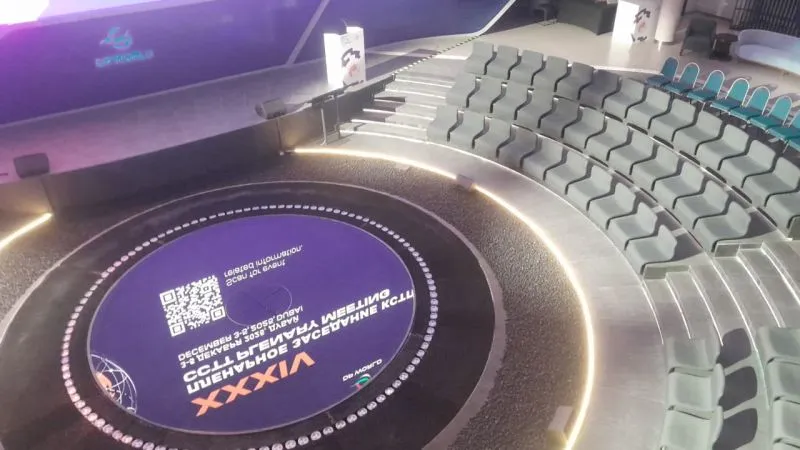
A circular plenary hall with tiered grey seats around a central floor printed with the meeting name and a QR code.
A plenary hall prepared for a two-day meeting in Dubai, December 2025.

What matters most

Fast speech, many names, live media

Sports press conferences are short, fast and full of proper nouns. A coach answers in Spanish, a player in Portuguese, a journalist asks in Arabic, and everyone wants the quote straight away. Athlete names, team names and competition terms must come out the same way every time, and the press needs a record they can check before they publish.

Typical sessions

Where we work in this sector.

  • Pre- and post-match press conferences

    Coaches and players answering questions from regional and international media, often in three or more languages in twenty minutes.

  • Media days and launches

    Tournament launches and kit or sponsor announcements, where sponsor and product names must be exact.

  • Team and officials' briefings

    Technical meetings, rules briefings and officials' seminars for international teams and referees.

  • Fan forums and meet-the-team events

    Fan events in malls, arenas and fan zones, where the audience reaches for a phone rather than a receiver.

  • Award nights and galas

    Award ceremonies and entertainment galas with speeches between performances, for guests from many countries.

How we run it

From the first call to the last file.

  1. Names before anything else

    We build the glossary from team sheets, squad lists, officials, sponsors and venues, with agreed spellings and pronunciations, and refresh it before each match day.

  2. Feed from the press desk

    We take the feed from the press conference mixer, so the top-table microphones and the journalists' question microphones all reach the interpretation.

  3. QR on the backdrop and seats

    The QR goes on the press seat cards, the media centre screens and the accreditation lanyard, so journalists join in seconds.

  4. Monitored live

    Our team monitors every channel throughout, adds a language when a visiting team arrives, and stays in touch with the media officer.

  5. Quotes ready to check

    The media team receives transcripts per language and recordings of every channel, so journalists and the club can check quotes before publishing.

When to add a human interpreter

For disciplinary hearings, anti-doping proceedings, contract negotiations and any sensitive statement where a misquote could cause harm, choose Sim Trans human interpreters. For a high-profile press conference with a global audience, a hybrid works well: a human interpreter for the main language pair, and SIM.AI for the additional languages in the room.

AI and Sim Trans interpreters together

Built for the press room, not the commentary box

The UAE hosts international football, cricket, tennis, golf, motorsport, combat sports and esports, along with concerts and award nights. Most of the spoken content around those events happens off the field: press conferences, media days, technical briefings and fan events. That is where AI interpretation fits. One person speaks at a time, through a microphone, to an audience that wants to understand straight away.

Live commentary is a different matter. Fast speech over crowd noise, with several voices overlapping, is the hardest case for machine interpretation. We say so plainly and recommend against it.

An example from Abu Dhabi

An international football tournament holds its press conferences in a stadium media centre in Abu Dhabi. Each match day has two pre-match and two post-match conferences, with coaches who speak Spanish, Portuguese, French and Arabic.

  • Channels: Arabic and English for every conference, plus the languages of the two teams playing. Russian is added on day four when a visiting broadcaster arrives.
  • Glossary: every squad member, coach and official by name, with Arabic spellings agreed with the tournament’s media team, plus sponsor names and stadium names. Run in Precision mode so pronunciation is fixed.
  • Questions: journalists ask from the floor microphone in Arabic or English; coaches answer in their own language; the system follows each change automatically.
  • Afterwards: the media team receives transcripts per language and recordings of every channel, so journalists can check a quote against the audio.

Names are the whole game

In sports media, the most common error is a name. A player’s name transliterated three ways in Arabic, or a coach’s name misheard, undermines a quote. The fix is preparation: squad lists in Latin and Arabic script, pronunciation notes, and a glossary refreshed before every match day. Our article on how to prepare a glossary for an interpreted event applies directly. For agreed Arabic spellings, see our notes on Arabic interpretation.

Entertainment and gala nights

At an awards evening or a gala, interpretation is about the speeches between performances. Music is not interpreted. Comedy and wordplay are where machine interpretation is weakest, so a host who relies on jokes should expect some to fall flat in other languages. Guests who want to follow quietly can choose captions only.

What the media team receives

Deliverable Use
Transcripts per language (.docx, .xlsx) Checking quotes, press releases, club media
Recordings of every channel Verifying a quote against the audio
Subtitle files Press conference clips on social and club channels
Usage report Which languages journalists and fans chose

The transcripts and records page sets out each format in detail.

Questions organisers ask

How do you handle athlete and team names?

We load every name from the team sheets, squad lists and officials' lists into the glossary before the event, with agreed spellings and pronunciation. For tournaments, we refresh it before each match day. Names are still one of the hardest things for machine interpretation, so the glossary matters.

Can journalists use the transcripts for quotes?

They are a useful starting point. You receive written transcripts per language and recordings of every channel, so a quote can be checked against the original audio before it is published.

What happens when the coach and a journalist use different languages?

The system follows the speaker automatically when the language changes, so a question in Arabic and an answer in Spanish both reach every channel without anyone pressing a button.

Does it work in a noisy arena or fan zone?

It works when the audio comes from the stage or PA mixer, not from a microphone listening to the crowd. In loud spaces, fans can choose captions only and read along on their phones.

Can it interpret live match commentary?

Fast, overlapping commentary over crowd noise is the hardest case for machine interpretation, so we do not recommend it for live commentary. SIM.AI works best for press conferences, briefings and speeches, where one person speaks at a time.

Planning an event?

Let’s talk about your event.

Tell us the venue, the date and the languages. We reply within 24 hours with a plan and a quote.

Call
+971 56 685 4225
Email
ai@sim-trans.com
Based in
Dubai and Abu Dhabi, serving the UAE and GCC