Compare
AI or human interpretation? Often, both.
We provide both, so we have no reason to oversell either. AI interpretation covers more languages with less on the floor. Human interpreters carry nuance, protocol and legal weight. Here is how we help clients decide, session by session.
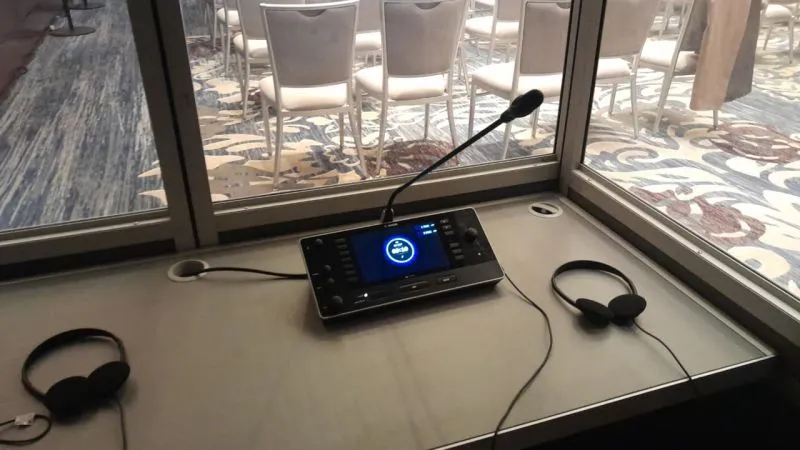
Side by side
What each does well.
| SIM.AI interpretation | Sim Trans human interpreters | |
|---|---|---|
| Names, titles and specialist terms | Good with a glossary; Precision mode enforces them. Unprepared names are the most common error. | Strong, especially with preparation. Interpreters ask, check and adapt. |
| Nuance, humour, idiom | Literal more often than not. Jokes and cultural references can fall flat. | Interpreters carry intent and tone, not just words. |
| Delay behind the speaker | A few seconds. | A few seconds, varying with the speaker and the language pair. |
| Languages at once | Up to 12 from one feed, chosen from 81. | One language per booth team; each language adds a booth and two or more interpreters. |
| Late changes | A new language is a setting, even mid-session. | Depends on finding qualified interpreters for that pair at short notice. |
| Equipment on the floor | One small table. Guests use their own phones. | Booths, consoles, receivers and headsets, or a remote platform. |
| Record afterwards | Audio, transcripts and subtitle files for every channel, included. | Recordings if arranged; transcripts are a separate job. |
| Legally binding or high-stakes content | Not on its own. Use with human review or alongside human interpreters. | The right choice. Sim Trans provides certified interpreters. |
Decision guide
Three questions decide most sessions.
Will anyone rely on the interpretation as a record or as evidence?
If yes, use certified human interpreters. SIM.AI can still provide transcripts and captions alongside.
Does a misunderstanding carry a diplomatic, medical or commercial cost?
If yes, put a human interpreter on that session, or use Precision mode with a reviewed glossary for technical content.
How many languages does the room need?
Beyond two or three languages, AI channels usually make the difference between covering everyone and covering the majority.
Typical recommendations
What we usually advise.
- Court hearing, arbitration or deposition Human Certified interpreters. The interpretation may be relied on as evidence.
- Head-of-state or ministerial meeting Human Protocol, nuance and discretion come first.
- Medical consent or patient consultation Human Never machine interpretation alone.
- International summit main stage Hybrid Human interpreters for Arabic and English, AI channels for the rest.
- Company town hall in four languages AI Custom glossary for names and product terms; captions for the back rows.
- Training day or workshop series AI Consistent terminology, records for everyone who missed it.
- Exhibition stage programme AI Captions help in noisy halls; add languages as visitors arrive.
- Community lecture in Arabic, Urdu and Malayalam AI or hybrid Agree in advance how quoted scripture is handled.
Questions organisers ask
Is AI interpretation as good as a human interpreter?
Not in every respect. For clear speech on a known subject with a prepared glossary, it is good enough for most conferences, briefings and town halls. It is weaker on unprepared names, humour, overlapping speakers and poor audio. For high-stakes or legally binding sessions, human interpreters remain the right choice.
Is AI interpretation cheaper?
Often, for events that need many languages or long hours, because there are no booths to build, receivers to rent or interpreter teams per language. For a short session in one language pair, the difference can be small. We quote both so you can compare.
Can we use both at the same event?
Yes, and many events should. A common set-up is Sim Trans interpreters for the main language pair on stage, with SIM.AI channels covering the other languages, all run by one team.
Who decides which sessions get human interpreters?
You do, with our advice. When you share the programme, we mark the sessions where we would recommend a human interpreter and explain why.
Next: compare SIM.AI with traditional booths and receivers, or read what live AI interpretation is.