Compare the set-ups
Both start at the sound desk. Everything after that changes.
Booths, consoles and receivers have served events well for decades, and Sim Trans still provides them. A phone-based system does the same job with far less on the floor. Here is the difference, honestly.
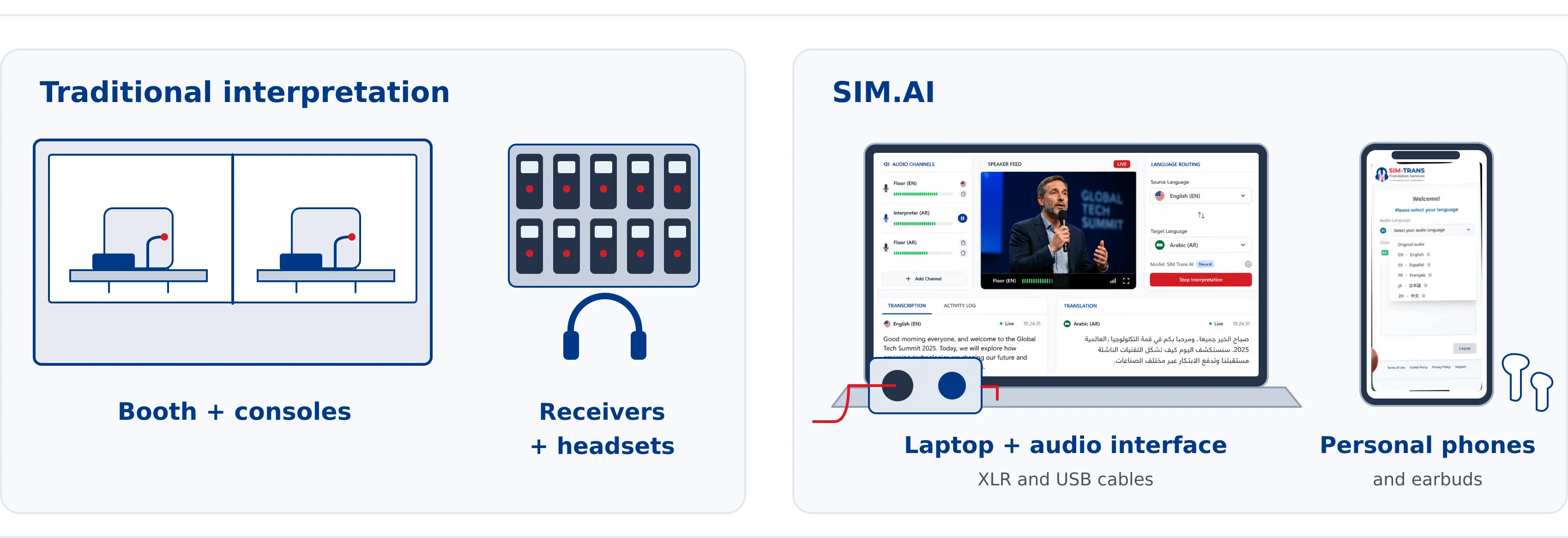
Nothing to build
No booths in your floor plan, no equipment tables at the back of the room, no cable runs across the venue.
Nothing to hand out
No receiver counts, no deposits, no collection queue at the door, no units lost between sessions.
Nothing to rebuild
A late request for another language is a change of setting, not a change of budget and floor plan.
Side by side
What changes for you, the venue and your guests.
| Booths and receivers | SIM.AI | |
|---|---|---|
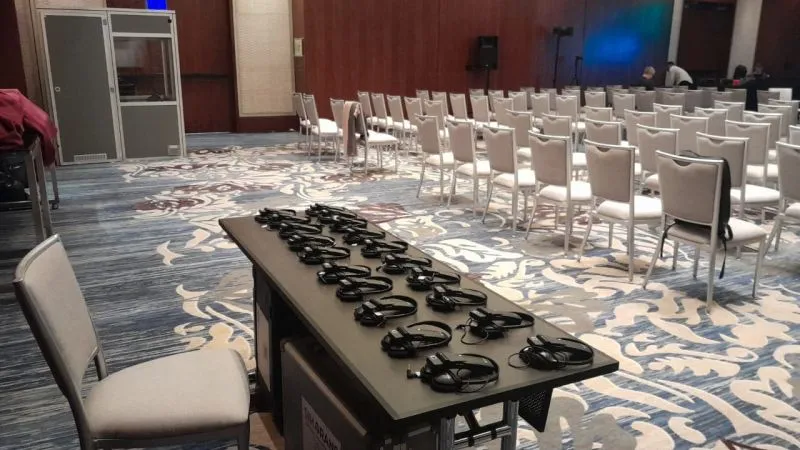
| On the floor | One booth per language, consoles, an equipment table at the back, cable runs. | One small table at the side of the room: a laptop and an audio interface. |
| For each guest | A receiver and headset, issued and collected, with deposits or ID checks. | Nothing. Guests scan a QR code and use their own phone and earbuds. |
| Audio from the venue | Floor feed to the booths; booth output to the transmitters. | One clean feed from the venue sound desk. |
| Languages | Each language needs its own booth and interpreter team. | Up to 12 at once from one feed, chosen from 81. |
| A late language request | A new booth, new interpreters, a new floor plan. | A change of setting, even during the session. |
| Number of listeners | Limited by the receivers you rent. | Unlimited: twenty guests or five hundred. |
| Captions | Not included. | Live captions in every language, with “Show original”. |
| After the event | Recordings if arranged. | Audio, transcripts and subtitle files per language, plus a usage report. |
Honest guidance
When booths still make sense.
- The session needs human interpreters and the room has no reliable internet.
- Phones are not allowed in the room, for security or protocol reasons.
- The audience is unlikely to carry smartphones or earbuds.
- The venue has an installed infrared system you want to use today. (Output from SIM.AI to conference systems is coming soon.)
For these events, Sim Trans provides booths, consoles, receivers and technicians from its own inventory, and certified interpreters to work in them.
Questions organisers ask
Is a phone-based system always cheaper than booths?
Not always. Costs depend on duration, the number of languages, whether human interpreters are needed and the venue. Phone-based interpretation removes the booth build, receiver rental and the logistics of handing out and collecting equipment, which matters most for larger audiences and more languages. We quote both when it is a close call.
When are booths and receivers still the better choice?
When the content needs human interpreters and the room has no reliable connectivity, when phones are not allowed in the room, or when the audience is unlikely to carry smartphones. Sim Trans still provides booths, consoles and receivers from its own inventory for these events.
Can SIM.AI feed an installed conference system?
Output to conference systems such as Bosch DICENTIS, Integrus infrared and Dante networks is coming soon. Today, guests listen on their own phones.
Do guests need good mobile signal?
Guests need either venue Wi-Fi or mobile data. We check coverage with the venue in advance, especially in basements and large halls.
See also AI vs human interpretation and how SIM.AI works on the day.